
Technical:
Coagulation


INTRODUCTION
Cheesemaking has been known for 8,000 to 9,000 years. When our early ancestors abandoned their nomadic lifestyle and began settling in communities with emerging social structures, they also started domesticating animals, first goats and sheep, and later cattle. These animals were used very efficiently: meat was consumed, hides were used for clothing, bones served as tools, and internal organs were also utilized. Intestines were made into ropes or strings, and the stomach, when sealed at one end, functioned as a natural container. In ruminants, this was even more advantageous: four stomach compartments for the price of one. By chance, one particular stomach, the abomasum, had a special property: when milk was stored in it, it quickly transformed into solid curds and a watery liquid. This is most likely how cheesemaking was discovered and rediscovered dozens, if not hundreds, of times independently. It still forms the basis of modern (artisanal) cheesemaking.
In cheesemaking, coagulation is one of the most important steps. It is the process by which liquid milk transforms into a thicker, gel-like mass. Milk consists largely of water, but also contains proteins (mainly casein), fats, and sugars. These proteins normally remain dispersed, keeping the milk in a liquid state. When rennet is added, something remarkable happens: the rennet causes the casein proteins to bind together. More specifically, rennet cleaves a portion of the casein protein, causing the proteins to lose stability and aggregate. This forms a network that traps fat and water. This network becomes the curd (solid mass), while the remaining liquid is called whey. The milk thickens and changes from a liquid into a soft, pudding-like structure, this is the foundation from which cheese is made.
We can distinguish the following types of rennet:
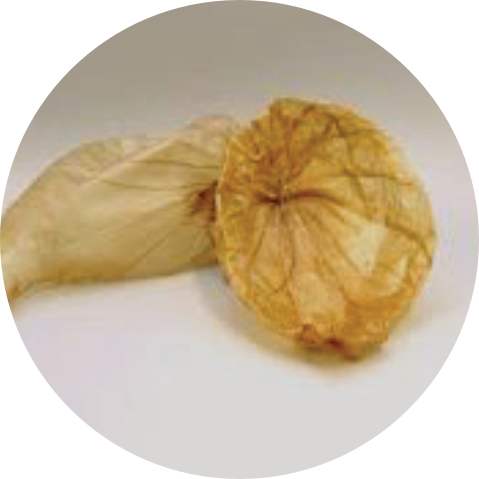
Calf Rennet
Animal rennet is extracted from the lining of the abomasum (fourth stomach) of young calves. Rennet from sheep and goats also exists. Cheese made with animal rennet is not considered suitable for vegetarians. Most protected designation cheeses (PDO/PGI) are produced using animal rennet.
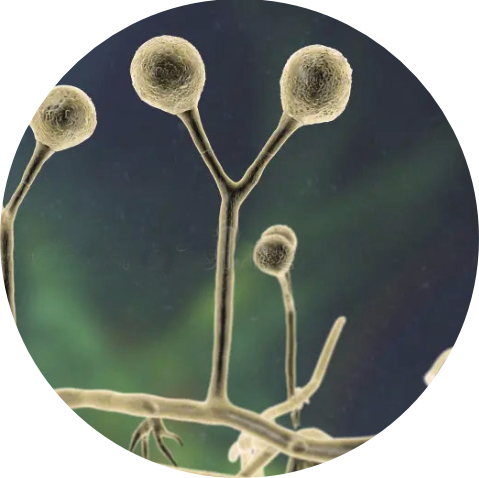
Microbial Rennet
This type of rennet is of non-animal origin and is therefore suitable for vegetarians. A more commercial term is “vegetarian rennet.” It consists of pure chymosin, the milk-clotting enzyme, produced either by a natural mold (Rhizomucor miehei) or by a genetically modified yeast (Kluyveromyces lactis) that produces the enzyme more efficiently.

Rennet Paste
The most traditional form of rennet. It is made from salted, finely ground abomasum. In addition to the milk-clotting enzyme chymosin, it also contains other enzymes that break down fats and proteins, contributing to a more complex flavor profile in the cheese. Rennet paste from sheep and goats can also be obtained from their salivary glands.

Cardoon Rennet
A truly plant-based rennet. It is an extract from the flower pistils of cardoon (Cynara cardunculus), a type of thistle. Cardoon rennet is more difficult to dose accurately and can impart a characteristic slight bitterness in longer-aged (pressed) cheeses, as these typically require higher amounts of rennet. It is mainly used for lactic cheeses.

Other
Some texts also refer to the milk-clotting properties of sweet woodruff (Galium odoratum). However, this no longer has any commercial application. The latex (sap) from young spring fig shoots also has a mild coagulating effect. It imparts a distinctive and recognizable aroma to the cheese and is often used in combination with lemon juice.
How does coagulation actually work?
Milk contains three types of proteins: casein (80%) and whey proteins (albumins and globulins, 20%). Casein is the protein that ultimately ends up in the cheese.
In milk, casein is present in the form of “micelles”—small particles that are normally well dispersed in the milk.
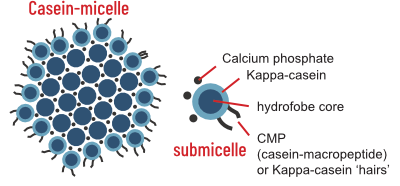
Coagulation occurs in two phases:
1 During acidification by lactic acid—produced by lactic acid bacteria—an initial aggregation of the casein takes place.
2 Subsequently, upon the addition of rennet, a more definitive binding occurs under the influence of rennet enzymes.
To explain how this works, a bit of biochemistry is required, my apologies.
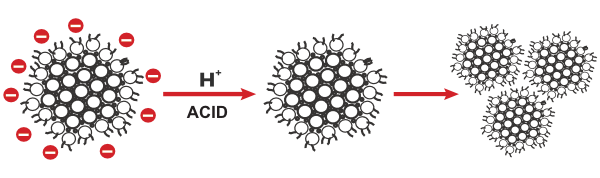
At neutral pH, casein micelles carry a negative charge and repel each other. Lactic acid bacteria produce lactic acid, causing the pH of the milk to decrease. Once the isoelectric point is reached (pH = 4.6), the micelles lose their negative charge and begin to aggregate. This is what occurs in lactic cheeses, where acidification plays the primary role in coagulation, rather than rennet. The same mechanism is responsible for coagulation in yogurt. Aggregation through acidification results in a weaker gel compared to enzymatic coagulation.
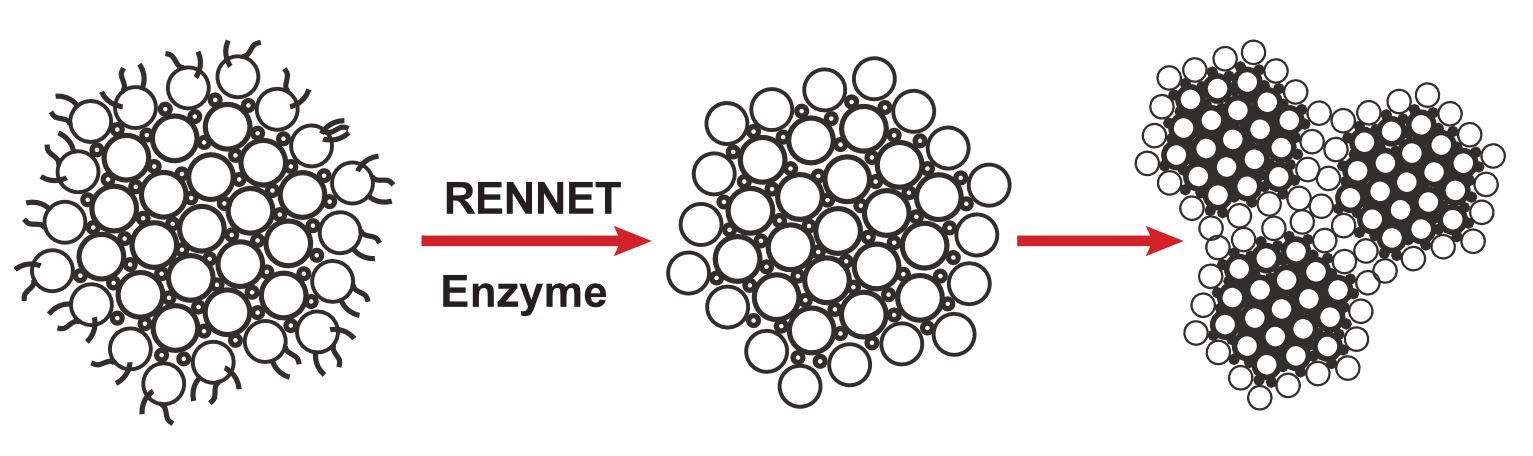
On the surface of a casein micelle, there are “hairy” protrusions (casein macropeptides, CMP) that prevent the micelles from aggregating. Under the action of rennet enzymes, these hairs are “cut,” allowing the micelles to come closer together. The free calcium in the milk acts as a glue, forming calcium bridges between micelles. In pasteurized milk, this free calcium is largely absent. That is why calcium chloride is added to pasteurized milk; otherwise, coagulation is weak or may not occur at all.
Microbial Rennet
and the GMO Issue
The most common alternative to animal rennet is produced from microorganisms. There are two types:
1. Microbial rennet produced using yeast.
The gene from a calf has been inserted into the DNA of a yeast (Kluyveromyces lactis). This yeast can now produce the same enzyme (chymosin) and thus rennet, just like a calf. This means the yeast is genetically modified. This does not have to be indicated on the packaging, because the final product—rennet itself—is not genetically modified. From a regulatory standpoint, the origin apparently does not matter. Nearly all industrially produced cheeses are made using microbial rennet, with the GMO version being the most widely used (as it is the cheapest). As a consumer, it is therefore difficult to determine which type has been used.
2. Rennet produced by a mold.
Its origin lies in a non-genetically modified mold (Rhizomucor miehei), from which the enzyme protease is extracted, with an activity very similar to chymosin. Therefore, for those with ethical concerns, this type of microbial rennet is the preferred choice.
Animal Rennet (Calf Rennet)
Animal rennet is a solution containing digestive enzymes. It is obtained from the abomasum of a milk-fed calf less than 30 days old. During this period, the protein-splitting enzyme—chymosin—is at its strongest because it has not yet been replaced by general proteolytic enzymes. Chymosin specifically causes only the casein in milk to coagulate, a process also called “renneting” or curdling.
What is special about chymosin is that it attacks a single protein at a specific point. Other enzymes act on multiple proteins simultaneously, cutting them into pieces. Chymosin primarily targets the protein kappa-casein.
In addition to calf rennet, rennet can also be obtained from goats and sheep. These animals are ruminants as well and have an abomasum from which rennet can be extracted, although it is more common to obtain this rennet from their salivary glands.
To respect the origin and tradition of a cheese, it is recommended to use the corresponding rennet for goat and sheep cheeses.
Rennet Strength: IMCU… What’s That?
IMCU stands for International Milk Clotting Unit, defined in 2007. It is a highly technical measure of rennet strength. One milk-clotting unit is defined as: “The amount of rennet enzyme required to coagulate 10 ml of rehydrated skim milk powder at 30 °C in 100 seconds.” As you can imagine, this is not very practical for calculating the rennet needed for your cheese. While formulas exist, they are theoretical and rarely used in practice. Instead, it is best to follow the dosage instructions on your purchased rennet bottle. For example, Naturen 145 (145 IMCU/ml) sold by Milk&Magic is used at: 25 ml per 100 L of milk, or approximately 4 drops per liter for pressed cheeses, and a maximum of 1 drop per liter for lactic cheeses.